
DOTS calculator
Enter your sex, body weight, squat, bench press and deadlift to see your total, five scores and your DOTS tier.
- Wilks 2.0
- —
- Wilks Classic
- —
- IPF GL
- —
- IPF Legacy
- —
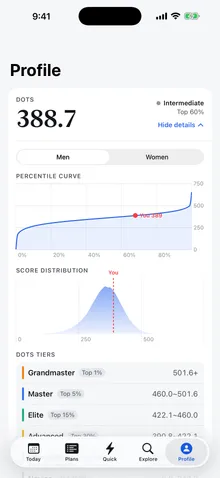
- GrandmasterTop 1%501.55+
- MasterTop 5%459.96~501.55
- EliteTop 15%422.11~459.96
- AdvancedTop 30%390.82~422.11
- IntermediateTop 60%342.18~390.82
- NoviceTop 100%0.00~342.18
What is a good DOTS score?
It depends on who you compare yourself with. The tiers rank you against OpenPowerlifting’s Tested Raw SBD results: drug-tested lifters who competed raw in all three lifts. Everyone in that group has entered a meet, so the bar is higher than in a typical gym.
| Tier | Ranking | Men | Women |
|---|---|---|---|
| Grandmaster | Top 1% | 501.55+ | 491.43+ |
| Master | Top 5% | 459.96–501.55 | 437.12–491.43 |
| Elite | Top 15% | 422.11–459.96 | 391.30–437.12 |
| Advanced | Top 30% | 390.82–422.11 | 354.77–391.30 |
| Intermediate | Top 60% | 342.18–390.82 | 300.48–354.77 |
| Novice | Bottom 40% | Below 342.18 | Below 300.48 |
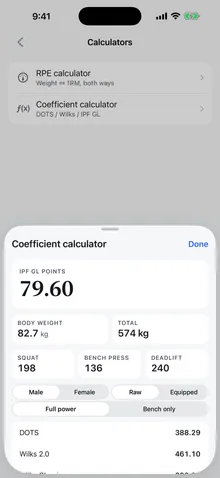
Example: a man weighing 82.5 kg with a 600 kg total gets a DOTS score of 406.44, which puts him in Advanced (Top 30%).
DOTS vs Wilks vs IPF GL
Each formula divides your total by its own body-weight curve and lands on its own scale, so a score only means something next to scores from the same formula. The same totals under each one:
| Lifter | DOTS | Wilks Classic | Wilks 2.0 | IPF GL |
|---|---|---|---|---|
| Man, 60 kg, 400 kg total | 337.6 | 341.1 | 398.7 | 65.6 |
| Man, 82.5 kg, 600 kg total | 406.4 | 401.9 | 482.7 | 83.3 |
| Man, 100 kg, 700 kg total | 430.9 | 426.0 | 510.6 | 88.4 |
| Woman, 52 kg, 300 kg total | 365.7 | 374.0 | 438.8 | 75.8 |
| Woman, 63 kg, 350 kg total | 376.4 | 375.9 | 447.5 | 76.6 |
IPF GL runs on a much smaller scale and Wilks 2.0 comes out higher than Wilks Classic, so don’t compare your DOTS with someone else’s Wilks or IPF GL points.
Which score does my federation use?
The IPF has scored its international meets, such as world and regional championships, with IPF GL points since 1 May 2020, and it asks its member federations to use them at national meets too.
OpenPowerlifting uses DOTS as its default ranking score, which is why TopSet’s tiers use it. Rules differ between federations and change over time, so check your federation’s rulebook for how best lifter is decided.
Does DOTS account for age?
No. The DOTS formula has no age adjustment: it uses only your sex, body weight and total. Instead, federations put sub-junior, junior and masters lifters in their own age divisions.
How to use it
- Pick your sex and enter your body weight.
- Enter your best squat, bench press and deadlift. Your total is worked out for you.
- Read your DOTS score and tier, and the other scores below it.
Your profile in TopSet shows your DOTS tier, and the coefficient calculator works without an account.
Download on the App Store →What the scores mean
Coefficients let lifters of different body weights compare totals. Each one divides your total by a curve fitted to body weight.
DOTS is the score OpenPowerlifting ranks by. Wilks 2.0 is the 2020 update of the classic Wilks formula. IPF GL is the formula the IPF uses for best lifter awards; this calculator uses the raw, full-power version.
Tiers are based on OpenPowerlifting’s Tested Raw SBD data and show where your score ranks in that group.
DOTS = total × 500 / (a + b·bw + c·bw² + d·bw³ + e·bw⁴)
IPF GL = total × 100 / (A − B·e^(−C·bw))
bw = body weight in kg; a–e and A–C differ for men and women